

The "Belt and Road" initiative unlocks new opportunities for China's industrial textile market
Release time:
2021-07-05
The textile industry can be broadly divided into three categories by application: industrial textiles, apparel textiles, and household (decorative) textiles. Currently, China mainly classifies industrial textiles by application, including 16 categories: agricultural cultivation; tarpaulins and canvas; geotextiles; labor protection and safety products; base fabrics for cultural, entertainment, and sports goods; medical and health materials and maternal and child health care materials; and national defense industrial materials.
In China, the industrial textile industry emerged in the 1950s. After half a century of development, it has become one of the three major pillar industries of China's textile industry.
Market Size
After China's accession to the WTO, driven by strong domestic and international market demand, the textile industry has entered a "fast lane," with continuous growth in industry scale and economic benefits. From 2016 to 2019, the price of industrial textiles fell, and sales also declined; in 2016, the sales of industrial textiles in China reached 308.197 billion yuan, and in 2019, it fell to 231.295 billion yuan. In 2020, the outbreak of the epidemic led to a short-term increase in the demand for emergency prevention and control materials such as masks and protective clothing, further increasing sales to 319.84 billion yuan. As the epidemic is brought under control, it is expected that the sales of industrial textiles in China will stabilize in 2021, reaching 269.796 billion yuan.
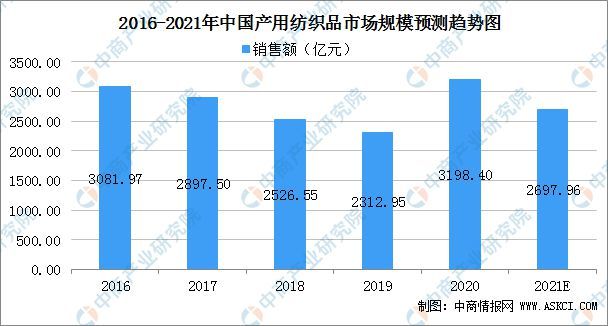
Data Source: Textile Industry Development Reports, Textile Statistical Yearbooks, and Industrial Textile Industry Development Reports of various years
Industry Development Prospects
(1) Economic Development and Improvement of Residents' Consumption Level
China's economy continues to develop, with GDP growth remaining at a high level for many years, and national income continues to grow. Currently, with the transformation and upgrading of China's social consumption structure, the consumption structure is shifting from subsistence consumption to development-oriented consumption, from traditional consumption to new consumption, and from quantity and price consumption to quality consumption upgrades. Industrial textiles have many advantages, such as high tensile strength, tear resistance, bonding strength, weather resistance, fire resistance, UV resistance, and strong airtightness. They are widely used in many fields such as sports and leisure, outdoor products, medical and health, safety protection, transportation, and construction engineering, which perfectly matches the current context of consumption upgrades, making the development prospects of China's industrial textile industry very broad.
(2) National Industrial Policies Promote Rapid Industry Development
In August 2018, the China Textile Industry Federation emphasized in the "Action Plan for the Development of Industrial Internet in the Textile Industry (2018-2020)" the need to strengthen the organization and guidance of the development of the industrial internet in the textile industry, organize industry resources such as qualified industrial clusters, professional markets, leading enterprises, and solution service providers to work together, actively explore and practice the construction and application of the industrial internet suitable for the characteristics and needs of the industry, and create a good basic environment for the development of the industrial internet in the textile industry.
In January 2020, the National Development and Reform Commission encouraged the use of non-woven, woven, knitted, braided, and other processes, as well as the combination of multiple processes and long-lasting finishing technologies, to produce functional industrial textiles in the "Guiding Catalog for Industrial Structure Adjustment (2019 Edition).
The introduction of the above-mentioned encouraging policies not only encourages the industry to actively innovate to meet the needs of various fields but also creates a good policy environment for the development of the industry, effectively promoting the stable and high-speed development of the industry.
(3) Technological Progress Continuously Expands Downstream Applications
Currently, the research and development of domestic industrial textiles mainly focuses on new raw materials, new production equipment development, functional finishing technology, and new composite processes. The improvement of related technologies has driven the improvement of product performance, enabling it to meet more and more needs in terms of both quality and functionality, thereby further expanding downstream market applications and promoting the overall upgrading of the industry.
(4) Strong Market Demand in Southeast Asia, Africa, and Other Regions, and Broad International Market Space
In recent years, with the rapid economic development of Southeast Asia, Africa, and other countries and regions along the "Belt and Road," and the moderate growth of demand in traditional markets such as Europe, the United States, Japan, and South Korea, the overall market demand will be further released, and Chinese enterprises will also have the opportunity to further expand their market space, creating favorable market conditions for the development of China's industrial textile industry.

Under the impact of the global COVID-19 pandemic, the garment industry in India and Southeast Asian countries has been severely affected, with some orders shifting to China. The phenomenon of textile orders returning to China against the current has become a hot topic in the industry.
At the 2020 China International Textile Machinery Exhibition and ITMA Asia Exhibition, Guangzhou Hongjing Lab Equipment Co., LTD, as a pioneer in intelligent manufacturing dyeing and finishing laboratories in China, showcased its latest intelligent integrated laboratory concept!
The Xida Xing Hongjing dyeing and finishing standard laboratory's overall design adopts a one-stop design for dyeing and finishing laboratories, divided into different functional areas: color measurement and matching area, light box color matching area, cloth cutting area, gray cloth preparation area, fabric opening area, dripping area, manual dripping area, sample dyeing area, reproduction area, and finishing area. Each area is equipped with dyeing and printing experimental equipment independently researched and developed by Hongjing, perfectly matching the laboratory's sample making and reproduction process.
In the first two months of this year, against the backdrop of the low base effect caused by the epidemic in the same period last year, China's total goods trade exports and textile and garment exports both achieved high-speed growth of over 40%. Cumulative exports of textiles and garments reached 301.36 billion yuan, an increase of 44.7%, with textile exports reaching 144.44 billion yuan, an increase of 50.2%, and garment exports reaching 156.92 billion yuan, an increase of 40.0%.
Contact Us
MS.JINGHUA ZHOU (Emily)
mobile:(+86)13925171028
Company address: B2 Building, No.3823 Guangxia Road, Baiyunhu Street, Baiyun District, Guangzhou
E-mail:export33@gzhongjing.com